
Michigan enters 2026 in one of the most fascinating positions of any program in college football.
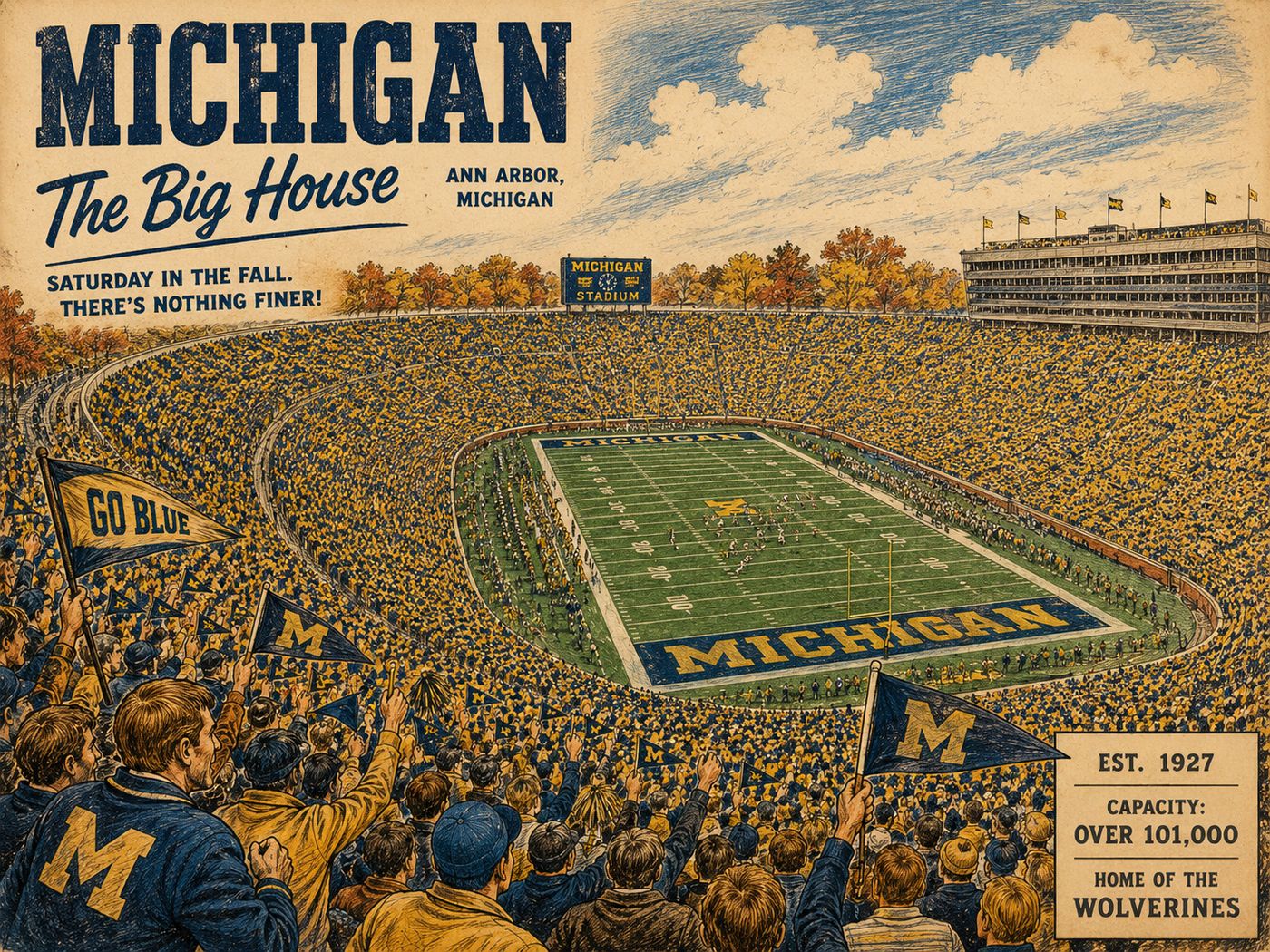
The Wolverines are only a few seasons removed from a national championship. They still recruit at an elite level. They have one of the most physically gifted young quarterbacks in America. They play in the biggest stadium in the sport.
And now they have Kyle Whittingham.
That might be the most important development of all.
After Michigan finished 9-4 last season, the Wolverines hired Whittingham following his extraordinary 21-year run as Utah’s head coach. He arrives in Ann Arbor with 177 career victories, three conference championships and eight 10-win seasons at Utah.
Michigan starts 2026 ranked No. 16 in the AP Poll, behind four other Big Ten teams.
That ranking feels appropriate.
There is too much talent here to dismiss Michigan.
There are also too many questions to automatically place the Wolverines alongside Ohio State and Oregon.
And almost all of them begin with one player.
Bryce Underwood.
Bryce Underwood Was Good. He Wasn't Great Yet.
Underwood arrived at Michigan as the No. 1 overall recruit in the country with expectations that would have overwhelmed most freshman quarterbacks.
Then Michigan put him on the field immediately.
Underwood became only the fourth true freshman quarterback to start for Michigan, joining Rick Leach, Chad Henne and Tate Forcier. He started all 13 games and finished with 2,428 passing yards, 11 touchdowns and nine interceptions, while adding 392 rushing yards and six touchdowns.
Those are respectable numbers for an 18-year-old quarterback playing Big Ten football.
They are not the numbers people imagined when Underwood arrived in Ann Arbor surrounded by Heisman and future No. 1 draft pick projections.
And that distinction matters.
Underwood flashed enormous ability.
He threw for 270 yards against Wisconsin. He produced 230 yards and two touchdowns against Washington. He threw for 280 against Northwestern. He ran for 114 yards against Central Michigan.
But there were also games where the passing offense virtually disappeared.
Against Michigan State, Underwood threw for only 86 yards.
Against Ohio State, he completed just eight passes.
Then, against Texas in the Citrus Bowl, Underwood threw three interceptions in a 41-27 loss.
That is what makes 2026 so compelling.
The physical talent is unquestioned.
Now the development has to catch up.
Enter Kyle Whittingham
There may not be many coaches better suited to Michigan's personality than Whittingham.
His Utah teams were physical. They tackled. They developed linemen. They ran the football. They played excellent defense. They rarely beat themselves.
And they routinely competed against programs with larger recruiting profiles and more resources.
Now imagine giving that coach Michigan's resources.
Whittingham built Utah into a national program without annual Top 10 recruiting classes. He produced winning seasons in 18 of his 21 years as head coach and won 10 or more games eight times. His 2008 team went undefeated and beat Alabama in the Sugar Bowl.
At Michigan, he does not need to manufacture talent.
It is already there.
His challenge is maximizing it.
And nowhere will that matter more than with Underwood.
Jason Beck Could Be the Key to Underwood's Development
Whittingham did something smart when assembling his staff.
He brought much of Utah’s offensive infrastructure with him.
Jason Beck is Michigan’s new offensive coordinator, while Koy Detmer coaches the quarterbacks. Offensive line coach Jim Harding and receivers coach Micah Simon also followed Whittingham from Utah.
That gives Michigan a very different offensive structure.
Whittingham's Utah teams were never dependent on quarterbacks throwing 45 times per game. They emphasized physical football, quarterback movement, play action and using the running game to make passing easier.
That could be ideal for Underwood.
Michigan should not ask him to become Patrick Mahomes.
It should ask him to become an efficient, dangerous quarterback who can create explosive plays when defenses overcommit to stopping the run.
At 6-foot-4 and 230 pounds, Underwood also gives Michigan a legitimate running threat.
He scored six rushing touchdowns last season.
That part of his game could become considerably more important.
Jordan Marshall Gives Michigan a Proven Running Back
Fortunately, Michigan still has the perfect player to take pressure off its quarterback.
Jordan Marshall may be one of the most underrated running backs in the Big Ten.
Marshall rushed for 932 yards and 10 touchdowns last season despite starting only four games. He averaged more than 124 rushing yards in his five career starts and earned second-team All-Big Ten recognition from the media.
His late-season emergence was especially encouraging.
Marshall ran for 185 yards and three touchdowns against Purdue.
He finished the year with seven touchdowns over his final five appearances.
Michigan has always been most comfortable when the running game dictates the terms of a game.
That philosophy should not change under Whittingham.
If anything, it should become even more pronounced.
Marshall gives Michigan a player capable of forcing defenses into heavier boxes.
And once safeties start creeping forward?
That is when Underwood becomes dangerous.
Andrew Marsh Could Become a Star
The other sophomore to watch is receiver Andrew Marsh.
Marsh quietly put together one of the best freshman receiving seasons in Michigan history.
He caught 45 passes for 651 yards and four touchdowns, setting Michigan's freshman single-season record for receiving yards. Against Northwestern at Wrigley Field, Marsh exploded for 12 catches and 189 yards, both freshman single-game records at Michigan.
That is enormously important.
Michigan has not consistently had elite wide receiver production in recent seasons.
Marsh gives Underwood a legitimate No. 1 target who is developing alongside him.
Think about the possibilities.
Underwood is a sophomore. Marsh is a sophomore. Several offensive linemen are young.
Michigan could be building an offensive core that stays together beyond 2026.
That makes this season about more than immediate results.
It could be the year the next version of Michigan football begins taking shape.
The Offensive Line Still Matters Most
Of course, none of this works without the offensive line.
Michigan's identity during its championship run was built up front.
Whittingham understands that better than almost anyone.
The Wolverines return experience at tackle with Blake Frazier and Andrew Sprague, while Jake Guarnera is moving to center. Michigan's staff has emphasized that those returning players have valuable game experience even as the unit adjusts to a new offensive system.
There are still questions at guard and with overall depth.
But the philosophy will be familiar.
Michigan wants to make defenses deal with five offensive linemen, tight ends and a physical running game for four quarters.
If the Wolverines can restore that identity, Underwood's life becomes dramatically easier.
The Defense Is Getting a Whittingham Makeover Too
Michigan also hired Jay Hill as defensive coordinator.
Hill worked under Whittingham at Utah and brings a similarly aggressive defensive mentality.
Michigan lost significant veteran production after 2025.
But the cupboard is hardly empty.
The defensive line includes Trey Pierce, Enow Etta, Cam Brandt and Nate Marshall.
The secondary includes Jyaire Hill, Zeke Berry, Rod Moore and Smith Snowden.
Several of those players already have extensive experience.
Michigan's 2025 defense intercepted 13 passes and recorded 28 sacks. Among the returning players, Jyaire Hill had 36 tackles, Zeke Berry had 33, and Trey Pierce had 30.
There is talent here.
The biggest question is whether Whittingham and Hill can get it organized quickly enough.
Rod Moore's Return Could Be Huge
One of the most interesting players on the roster is Rod Moore.
Moore has dealt with significant injuries and has not been able to play consistently for the last two seasons.
But he returns in 2026 as Michigan's active career leader with 147 tackles and seven interceptions.
If Moore is healthy, he gives Michigan something difficult to manufacture through the transfer portal: experience.
He understands the rivalry games. He understands Big Ten offenses. He understands what championship-level Michigan football looks like.
And according to Michigan's own preseason evaluations, Moore has looked encouraging physically during camp.
A healthy Moore could stabilize an otherwise changing defense.
The Schedule Starts Perfectly for a New Coach
Whittingham gets one major advantage in Year 1.
Michigan plays its first four games at home.
The Wolverines open against Western Michigan on September 5.
Then comes a much more interesting game: No. 10 Oklahoma at Michigan Stadium.
UTEP follows before Michigan opens Big Ten play against No. 22 Iowa.
That is a good setup.
Whittingham does not have to take his new team into a hostile environment immediately.
Underwood gets three straight home games before conference play.
And Michigan gets an early national measuring stick against Oklahoma without leaving Ann Arbor.
The September 12 game may tell us very quickly how seriously Michigan should be taken.
Oklahoma Is Underwood's First Chance at Redemption
There is another reason the Oklahoma game matters.
Michigan played at Oklahoma last season.
The Wolverines lost 24-13, and Underwood threw for only 142 yards in his first road start.
Now Oklahoma comes to the Big House.
Underwood is a year older. The coaching staff is different. The atmosphere should be enormous.
And Oklahoma enters ranked No. 10.
If Michigan wins, the Wolverines probably move quickly toward the Top 10.
More importantly, Underwood gets an immediate opportunity to show how much has changed.
October Could Put Michigan Into the Playoff Race
After Iowa, Michigan travels to Minnesota before getting a bye.
Then comes an enormous two-game home stretch: No. 18 Penn State followed by No. 6 Indiana.
This may determine Michigan's season.
Imagine the Wolverines reaching the bye at 5-0.
Penn State comes to the Big House with Matt Campbell and Rocco Becht.
Then defending national champion Indiana arrives one week later.
If Michigan wins both?
The conversation changes completely.
At that point, Michigan would not merely be a Top 25 team.
It would be a legitimate Big Ten championship contender.
And Then the Schedule Gets Mean
Michigan gets Rutgers and Michigan State after that.
Then comes November 14. At No. 2 Oregon. Autzen Stadium.
Then UCLA at home.
Then: at No. 1 Ohio State.
That is an extraordinarily difficult ending.
Michigan could be dramatically improved and still lose twice.
Going to Oregon is one of the hardest road trips in college football.
Going to Columbus is never easy.
And unlike last year, Ohio State will be waiting with the memory of finally ending Michigan's four-game winning streak in The Game.
The Ohio State Game Has Changed Again
Michigan's dominance in the rivalry ended last November.
Ohio State came to Ann Arbor and won 27-9, ending Michigan's four-game winning streak against the Buckeyes.
Now The Game returns to Columbus.
Michigan has won its last two trips to Ohio Stadium, in 2022 and 2024.
This will be Whittingham’s first experience with the rivalry.
He will understand quickly.
At Michigan, seasons are not evaluated strictly by overall record.
Ohio State changes everything.
A 9-3 Michigan season that includes beating Ohio State feels different from a 10-2 season that ends with another rivalry loss.
Whittingham has coached in emotional rivalries before.
Utah and BYU was rarely subtle.
But Michigan and Ohio State is a different level.
Can Michigan Compete With Ohio State and Oregon?
That is the real question.
Michigan is ranked No. 16. Ohio State is No. 1. Oregon is No. 2. Indiana is No. 6. USC is also ranked ahead of the Wolverines.
Michigan does not need to immediately prove it is better than all of them.
It needs to prove it belongs in the same conversation.
That is where Underwood becomes so important.
Whittingham can build the defense. He can create the culture. He can make Michigan physical.
But eventually, elite college football games become quarterback games.
When Michigan is down six points in the fourth quarter at Oregon, can Underwood make the throw?
When Ohio State loads the box against Jordan Marshall, can Underwood punish the Buckeyes?
When Indiana forces Michigan into third-and-9, can he keep the drive alive?
That is the next step.
This Could Be the Perfect Coach and Quarterback Combination
There is something almost counterintuitive about pairing Whittingham with Underwood.
Whittingham has built his reputation around toughness, defense and development.
Underwood arrived as one of the flashiest quarterback prospects college football has seen in years.
But that may be why this works.
Underwood does not need more hype.
He needs structure. He needs a running game. He needs a system that does not require him to be spectacular every snap.
And he needs coaches willing to make him earn everything.
Whittingham's programs have always been built that way.
If Underwood becomes great inside that structure, Michigan's ceiling changes dramatically.
Is Michigan a Playoff Team?
Maybe.
The schedule makes 10 wins difficult but absolutely achievable.
Michigan gets Oklahoma, Iowa, Penn State and Indiana at home.
That is a significant advantage.
The difficult road games are concentrated late, with Oregon and Ohio State waiting in November.
A plausible Michigan season could look like this: beat Oklahoma, handle Iowa and Minnesota, split Penn State and Indiana, beat Michigan State, lose at Oregon and enter Columbus 9-2.
At that point, everything would still be available.
A playoff berth. A 10-win season. Possibly even a Big Ten Championship appearance depending on the conference standings.
TD Strike Prediction
Michigan is better than a typical No. 16 team.
The Wolverines have one of the highest-upside quarterbacks in college football. They have a proven running back in Jordan Marshall. Andrew Marsh could become one of the Big Ten’s best receivers. There is experience on the offensive line. Rod Moore gives the defense veteran leadership.
And Michigan just hired one of the most accomplished program builders in college football.
But Year 1 under a new coaching staff rarely happens without complications.
There will be moments when Underwood still looks like a young quarterback. There will be defensive adjustments. And the trips to Oregon and Ohio State create two enormous obstacles.
Prediction: Michigan finishes 9-3, returns firmly to the national Top 15 and enters November with a realistic College Football Playoff opportunity.
The ceiling is 10-2.
If Underwood makes a major sophomore leap and Whittingham immediately establishes his defensive identity, the Wolverines could be one of the surprise teams in the Big Ten championship race.
And that may be the most important point.
Michigan does not need Bryce Underwood to become a superstar overnight.
It needs him to become a better quarterback every month.
Kyle Whittingham has spent more than two decades building teams exactly that way.
Michigan already has the talent. Whittingham brings the structure. Underwood brings the possibility.
If those three things come together, Michigan may not stay No. 16 for very long.